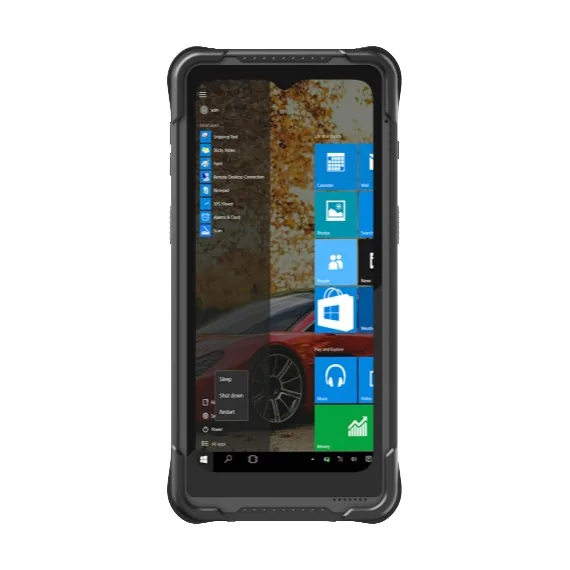
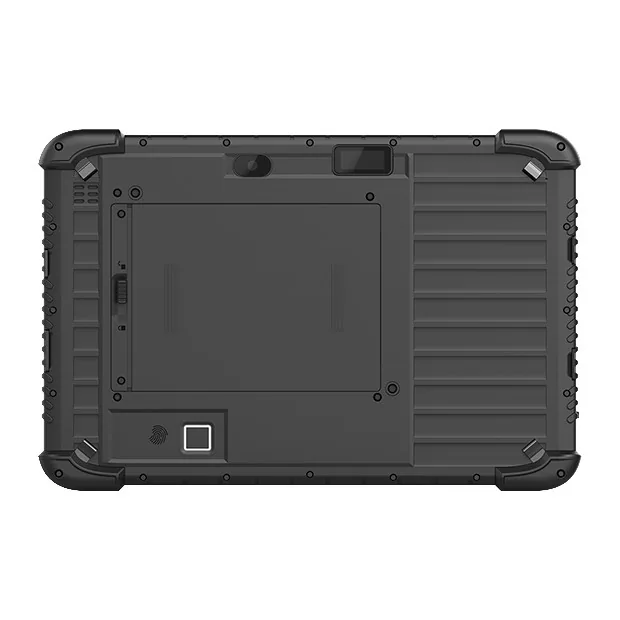
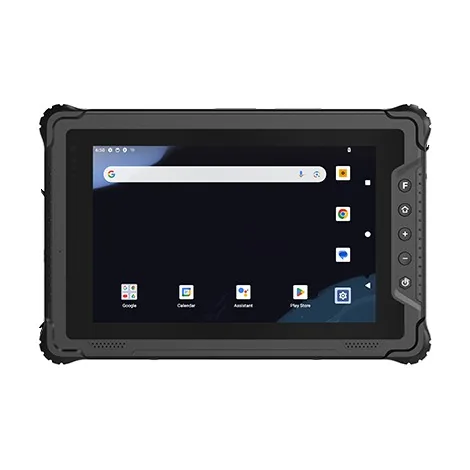
A put-away task on the top beam. The operator tilts the handheld up, and the location label sits 8.4 m above the floor. The standard 2D engine reports no read, so the operator does the thing that actually costs money: walks to the aisle-end terminal and types the location in by hand. The WMS accepts it. The record now holds a location the system trusts and the operator does not.
The reflex fix is "buy the long-range model". Often that is a 30–45% unit-cost increase applied to nine aisles so two stop generating exceptions — when a better label printer would have fixed it for the price of one handheld. This is the decision in between.
The short answer
- Under 5 m of working distance, on labels printed at 0.33 mm per module or better, a standard-range 2D imager is enough. Paying for range here is dead money.
- 5–8 m, operator on the floor or a picker platform: a mid-range or extended-range 2D head, depending on lighting and angle.
- Above 8 m, or a label on the far side of the racking: extended-range 2D, or a UHF RFID read on the location tag instead of a scan.
- If label quality is the constraint, no head fixes it. Every scanner reads pixels, and a 0.25 mm module printed at grade C does not have enough of them.
Buyers skip that last point, and it is why identical racking gets opposite recommendations.
The four head classes
"Long-range scanner" hides four different components. They are not points on one scale; they fail differently.
| Head class | Field range | Best at | Fails at |
|---|---|---|---|
| 1D laser / linear imager | 0.1–1 m | Fast clean 1D, low cost | Any 2D code, damaged or low-contrast labels |
| Standard-range 2D imager | 0.1–4.5 m | Pick aisles, cartons, shelf-edge | Top rack above ~5 m |
| Mid-range 2D imager | up to ~6–7 m | Mezzanine, 5–6 m racking, dock doors | Glare off shrink-wrap, steep angles |
| Extended-range 2D imager | 8–12 m datasheet, 6–8 m real aisle | High-bay 8–12 m, reach-truck put-away | 0.25 mm modules, motion, angled reads |
| UHF RFID handheld | 3–10 m on rack tags, 20 m class on a clear tag | Whole-beam reads, no aiming, no line of sight | Metal racking detuning tags, tag cost, no exact-bay precision |
1D laser still shows up in cheap quotations because some WMS front ends were written for Code 128 twenty years ago. A false economy in a mixed-code warehouse, and a dead end the moment anyone prints a QR label.
Why the datasheet number is not your number
Range is quoted on a lab target at optimum angle. In an aisle, four things move it: module size, print grade after three years of dust, substrate contrast, and the angle the operator can hold. Working distance scales roughly with module size, so a 0.5 mm label reads at nearly double the distance of a 0.25 mm one through the same optics — which is why "print better labels" is a hardware recommendation. The geometry is in what "10 metres" actually means in an aisle.
Rack-height bands
| Top label height | Specify | Avoid | Indicative unit delta |
|---|---|---|---|
| Up to 4 m | Standard-range 2D imager | Any long-range head | Base |
| 4–6 m | Standard head, plus a relocated label at 3 m on the upright | Long-range head bought for one bad bay | Base + relocation labour |
| 6–8 m | Mid-range 2D, or extended-range if the aisle is wide | Standard head with a reach tool | +15–25% |
| 8–12 m | Extended-range 2D | Laser, camera scanning | +30–45% |
| Any height, whole-pallet or bay confirmation | UHF RFID handheld plus location tags | RFID as a substitute for item scanning | Tag programme + handheld |
Those deltas are indicative trade figures, not quotations. The shape is what matters: long range is a real premium, and exception volume — not rack height alone — has to justify it.
The arithmetic that decides the order
Exception cost. Time one with a stopwatch: reach up, no read, walk to a terminal, type, walk back. In a wide-aisle 3PL that is 45–90 seconds. Forty put-aways a shift at 7% no-read gives three exceptions — three minutes. On labour alone, a premium head never pays.
Silent data decay. This is the number that gets budget approved. Once typing a location is easier than scanning it, operators type it, and typed locations are wrong at a rate nobody measures until the cycle count disagrees with the system. If a long-range head turns 7% manual entry into 0.5%, it has not saved four minutes — it has removed the main source of location error in the building.
Run it as premium per unit ÷ (exceptions avoided per shift × loaded cost per minute). If payback stretches past a year, check whether the exceptions sit in one aisle. Where they do, the honest answer is a mixed fleet: standard heads for six aisles, extended-range units for two, shared cradles, one firmware branch.
When the long-range head is the wrong purchase
- Relocate the tag. A label at 2.5–3 m on the rack upright reads at arm's length on a standard engine. Free, and it usually wins.
- Reprint larger. Doubling module size roughly doubles working range through the same optics.
- Fixed-mount reader at the aisle mouth. Reads every tote as it passes; no operator behaviour to train, higher capex.
- Put the scanner on the truck. A vehicle terminal with a mast-mounted reader suits high-bay work, because the truck is already at height.
What changes after you pick the head
Power. Extended-range engines draw more per read. A 4800 mAh pack that runs ten hours on a standard head may deliver seven on a long-range one, and less if the unit also carries UHF. Ask for decode current as well as capacity, and prefer replaceable packs. A pistol-grip body with an 8000 mAh pack sits near 600 g — fine for put-away, tiring across an eight-hour pick walk.
Aiming. Long-range reads need a visible aiming pattern and five minutes of coaching. Without it, first-week read rates look worse than the hardware is and the project gets blamed.
Integration notes for the WMS team
Keyboard wedge versus SDK. A head configured as a keyboard wedge types into whatever field has focus. When focus moves from location to quantity, a distant read lands in the wrong box. Use the SDK's intent or broadcast path, or enforce a focus lock. This causes more "the scanner is inaccurate" tickets than any hardware fault.
Pattern validation. Constrain accepted formats — bay, level, position — so a read of A-12-03 cannot be accepted during an A-12-04 task. Cheap to add, and it makes adjacent-label reads harmless.
Decode window. Cap the trigger at about three seconds, then raise an exception. Without a cap, operators hold the trigger and wait, which slows the task and hides a genuine no-read. Disable every symbology you do not print.
Pre-purchase checklist
- Measure top label height from the floor the operator actually stands on.
- Measure module size, or ask whoever prints the labels.
- Photograph the three worst labels — oldest, dirtiest, worst-lit.
- Tape three labels at install height; ten reads each at the real angle. Eight of ten is workable, six is a support queue.
- Count no-read exceptions for one week: the denominator of your business case.
- Request decode current and pack capacity separately, plus runtime at your ambient temperature.
- Confirm the SDK path and whether your WMS front end supports intent-based scan input.
- Buy one unit per head class, not one per vendor — the comparison is head-to-head in your own aisle.
- Run two weeks in one aisle with a supervisor logging every re-scan and manual entry.
- Fix the acceptance number first: first-read above 90%, manual location entry below 5%.
If you are searching for a shortlist
Searches for "best rugged PDA for warehouse scanning" return a hundred near-identical devices, because the term describes a form factor and not a job. The job here is narrow: read a specific location label at a specific height, in a specific light, without the operator changing what they do. Send the label height, a photo of the label, the aisle width and whether the operator is standing or on a truck, and you will get a head-class recommendation — standard, mid-range, extended-range, or RFID on the tag. We will say so when the cheap option is the right one.
WhatsApp +86 158 8972 3515 — send the photo first, it answers most of the questions.